

After the market's “Black Thursday,” the negative-news impulse looked largely exhausted. The better question was no longer what had just gone wrong, but which exposures still offered a favourable payoff into 2026.
1. Allocation for 2026
The framework pairs AI-linked growth exposure with gold and a diversified value sleeve, including emerging markets. The 2025 bull market had two visible engines: AI investment and fiscal or monetary support. Growth accelerated, liquidity stayed ample, inflation remained moderate and risk premia compressed. Apart from a short tariff shock, the fundamental trend held.
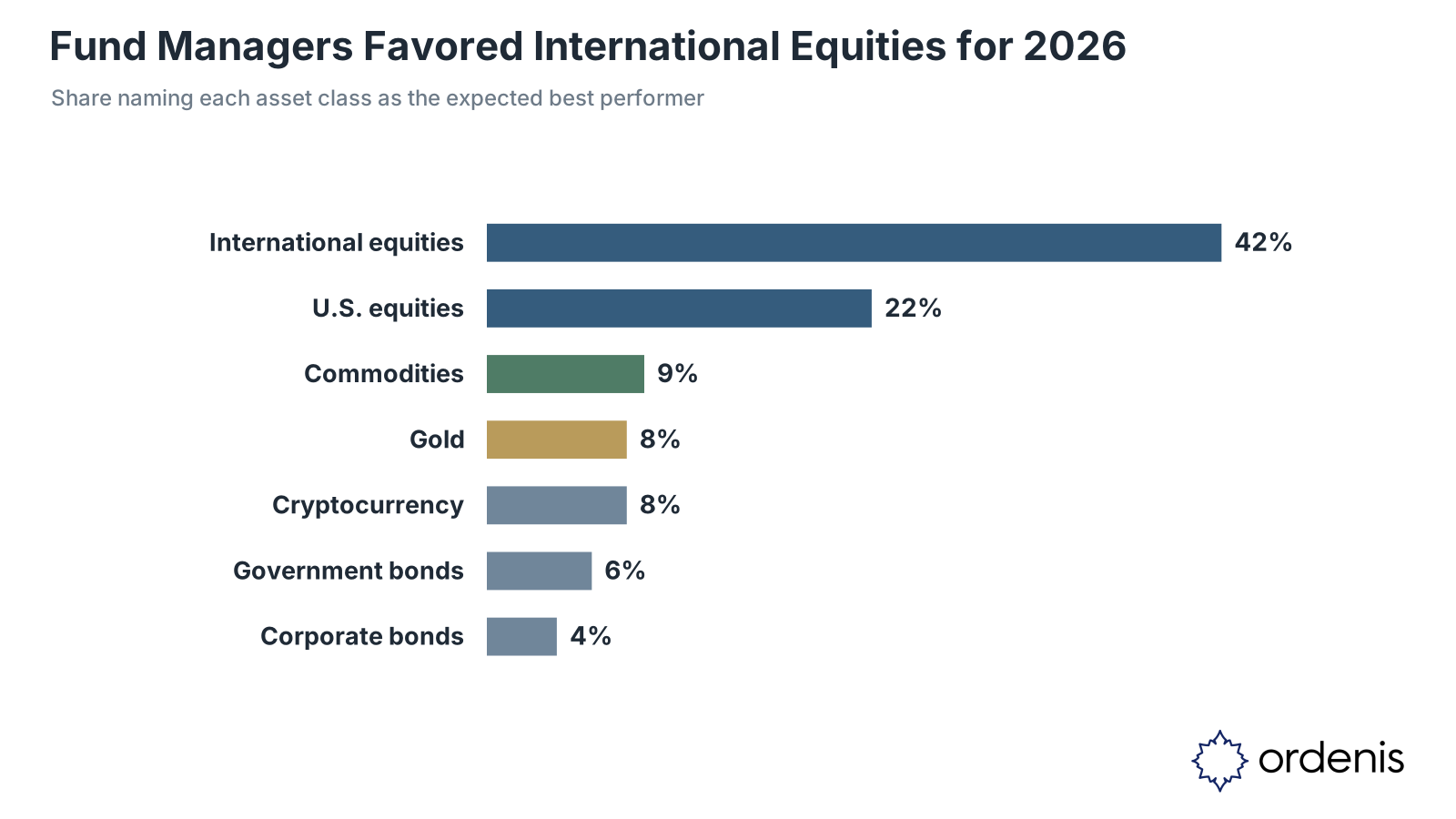
The rate-cut narrative rested on slowing U.S. activity, changing fiscal-policy expectations and debate over future Federal Reserve leadership. Market discussion of a possible leadership change reinforced the case for lower funding costs and a larger balance sheet. An “easing with a hawkish tone” was possible at the December meeting, which would create volatility without necessarily ending the longer liquidity cycle.
The risk is that the global equity market has already priced a great deal of easing. The tailwind of this year can become next year's headwind.
2. The AI bubble debate
The AI cycle has not reached a clear top. The practical question is how to participate and hedge it. AI is broad enough, deep enough and economically consequential enough to sit beside earlier industrial revolutions. Avoiding it does not remove systemic risk; it only makes it easier to lag the market.
The capital-spending debate has focused on data centers. Outages at AWS, Cloudflare and CME reminded investors that cloud compute is infrastructure for the modern economy, not only a temporary training demand. A new algorithm could reduce the amount of compute required, but the mainstream Transformer stack has not yet produced a technology that removes demand at scale. The supply system also has several routes to monetization, so “supply is structurally larger than demand” requires many assumptions.
Michael Burry has argued that compute is over-supplied, that accelerators depreciate too quickly and that AI leaders may be overstating their finances. Those claims do not invalidate AI. A GPU can be replaced while the application cycle continues.
Some private-credit structures are underwritten over two- to three-year horizons. Agents, robots and autonomous driving can keep appearing during that period, and the most profitable application may not yet be visible. The financial-structure risk is that if large AI companies fund a capital-expenditure race with debt, a larger debt burden can turn a valuation correction into a balance-sheet event.
The framework favours businesses with an independent growth curve, sound finances and durable non-AI revenue. Left-tail structures and derivatives can be used to define the cost of protection. “Hedging AI risk” is often a euphemism for owning less of it.
3. The gold thesis is unchanged
Gold remains a portfolio hedge when fiscal uncertainty, real-rate volatility or confidence in sovereign liabilities rises. Gold can also diversify AI-linked risk in ways Treasuries may not. After a large move, short-term entry points are less attractive, but the long-term monetary case remains testable.
4. A different market structure
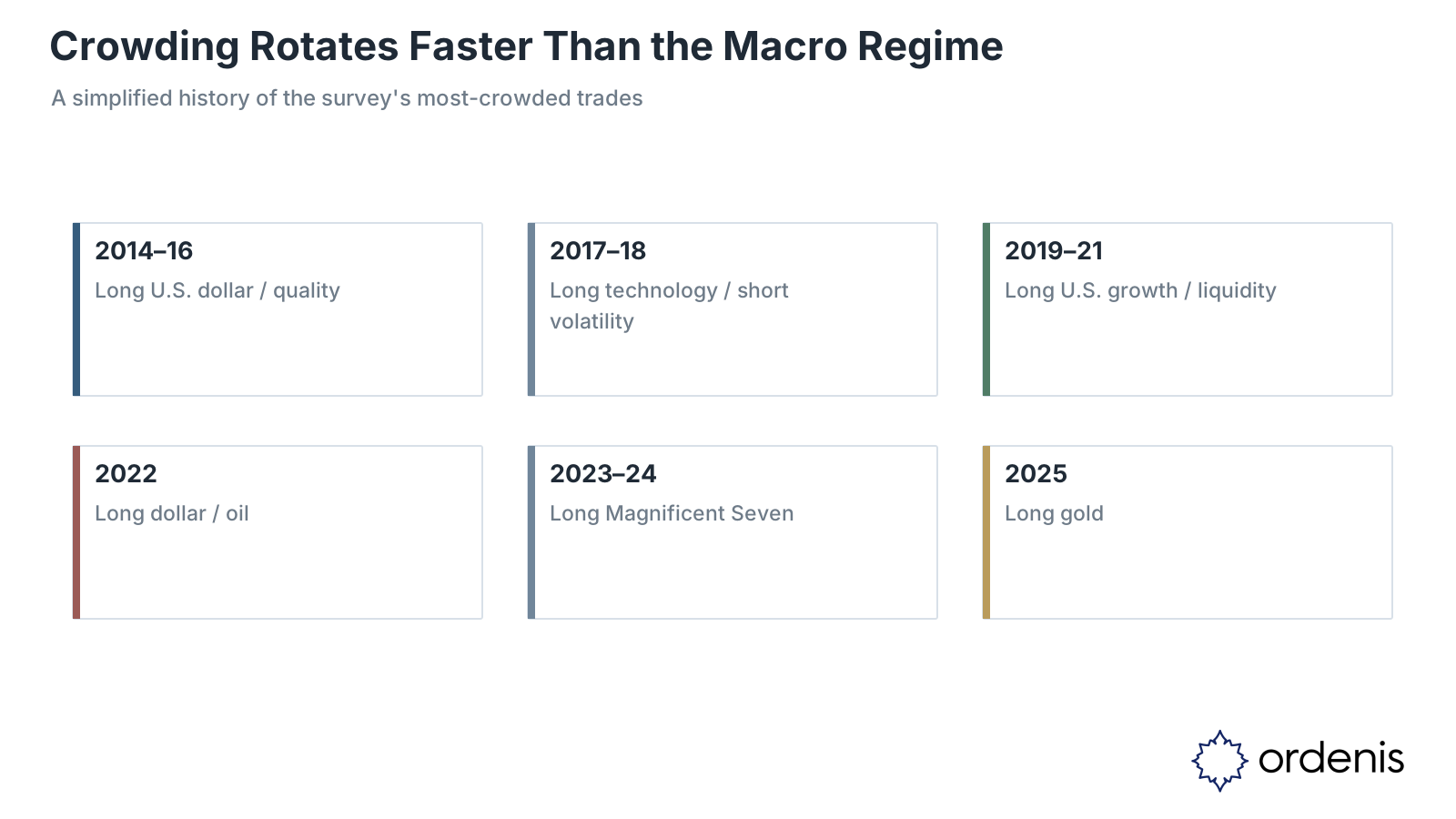
Markets are becoming more opaque. High-frequency trading, zero-day options, OTC financing and cross-market arbitrage create deeper displayed liquidity but also more correlated stress. Volatility rises, price can separate from fundamentals for longer and crowding matters more.
On-chain assets provide an observable, if noisy, measure of risk appetite and momentum. The sample can be monitored, but it should not be treated as a complete measure of market positioning.
5. Why macro hedging matters
As markets become more efficient, alpha is harder to earn. Beta enhancement is easier. A healthy market gives a trader room to express a view, but survival still comes first; the most volatile instrument need not carry the largest weight. Buy-the-dip behavior can persist in retail and low-frequency flows, although its edge may weaken.
Company economics anchor the thesis; the macro cycle shapes when the market rewards it. Capacity, financing structures and pricing power change slowly; positioning and policy expectations can move in a session. The edge is to separate the slow variables that define the regime from the fast variables that merely describe the latest move.